
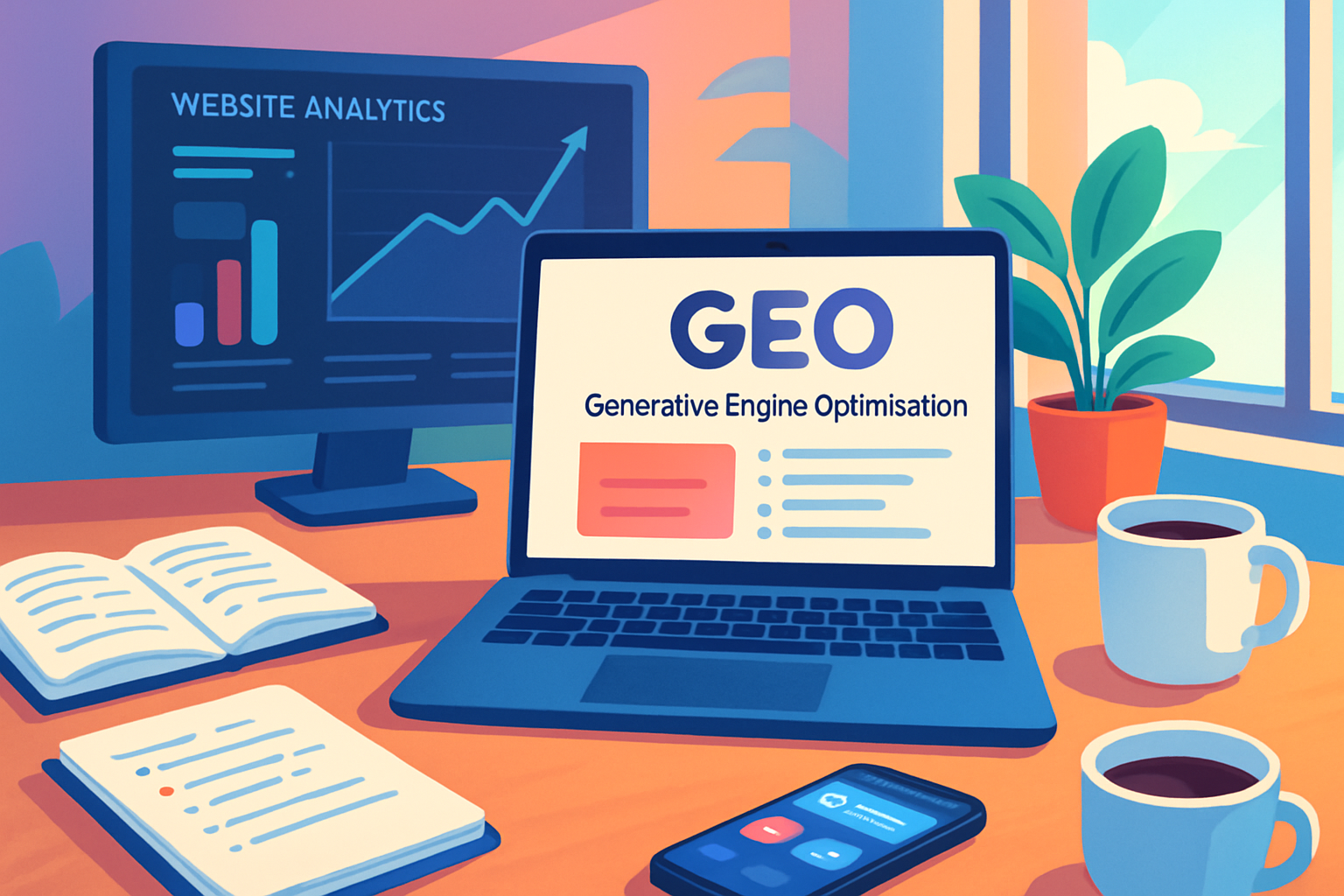
GEO (Generative Engine Optimisation) is the work that helps your business show up inside AI powered search answers.
Here are the three most important things to understand.
GEO explained in plain English
GEO stands for Generative Engine Optimisation.
It is the process of improving your website so AI powered search experiences can understand your content, trust it, and use it in their responses.
This is different to how most businesses think about search.
People are now asking full questions and expecting direct answers. They want a shortlist of options, a comparison, or a recommended next step. They are doing this inside AI tools and AI enhanced search results, not only through traditional browsing.
That shift matters because it changes where decisions happen.
Your customer might learn what they need, compare providers, and decide who to contact before they even reach a service page.
GEO helps make sure your business is part of that decision process.
GEO vs SEO vs AEO (and how they work together)
You do not need to replace SEO with GEO.
You need to understand how they fit together.
- SEO is still the foundation.
- AEO is the content execution layer.
- GEO is the strategy that shapes how your expertise appears across AI answers.
Here is the simplest way to think about it.
|
Approach |
What it focuses on | What you optimise | What success looks like |
|---|---|---|---|
| SEO | Search discovery | Site structure, technical health, content quality, authority | Qualified visitors and enquiries |
| AEO | Answer inclusion | Answer formatting, content structure, clarity, schema | Your pages are cited in answers |
| GEO | Generative visibility | Consistency, proof, topic coverage, source of truth pages | Your brand is referenced across prompts |
If you are new to this, start with the foundations.
Then improve your content using AEO style formatting.
Once you have that working, GEO becomes the strategy that helps you expand visibility across more questions, more pages, and more buying scenarios.
Why GEO matters for New Zealand businesses
New Zealand is a smaller market.
That sounds like a disadvantage, but it can be an advantage if your website is clear and trusted.
In many industries, buyers are not just looking for “a provider”. They are looking for someone they can rely on. They want to confirm credibility quickly, understand what is included, and know what to do next.
GEO matters because it helps your business appear when people ask the questions that drive decisions, like:
- What is the best option for my situation?
- How much should this cost in NZ?
- What is included in a service like this?
- What should I do first?
- What mistakes should I avoid?
If your website answers those questions clearly, it becomes easier for AI systems to reference you.
That is how GEO turns into demand.
Not by writing more content, but by publishing the right content in the right format.

What GEO is actually optimising
Most people assume GEO is just SEO with a new name.
It is not.
GEO is about making your business information easier to interpret and reuse.
In practice, that comes down to three things.
1) Your website needs to be a source of truth
AI systems do not want to guess.
If your website is vague, inconsistent, or missing details, it becomes risky to reference. The more uncertainty there is, the less likely you are to appear.
A strong GEO site is clear about:
- what you do
- who you help
- where you operate
- what is included
- what the process looks like
- what impacts cost and timelines
- why your business is credible
This is not about writing “more marketing copy”. It is about writing information that reduces doubt.
2) Your content needs to be easy to extract
GEO content is written in a way that is easy to summarise.
That means:
- definitions early
- short sections with clear headings
- step by step explanations
- practical examples
- tables when comparison matters
- FAQs that answer real buyer questions
If you already publish content, this is usually the fastest win. You do not need to change the topic. You need to change the structure.
If you want a detailed walkthrough of this style, you can check out our detailed guide here.
3) Your site needs proof that supports your claims
Generic content is easy to ignore.
The content that gets referenced consistently tends to include evidence, like:
- outcomes and results
- case studies and examples
- testimonials
- credentials and experience
- consistent business details across your site and listings
Proof lowers the risk of referencing you.
This is one of the biggest differences between “a helpful article” and “a trusted source”.
The 5 pages that drive most GEO results
If you are a business owner or marketing manager, this section matters.
Most GEO results come from improving pages that already sit close to enquiries.
Start with these five.
1) Your core service pages
Service pages are where people decide whether you are a fit.
If they are thin or generic, you lose trust quickly.
A strong service page should explain what is included, who it is for, what the process looks like, and what a realistic outcome is.
2) Your About page
Your About page is often where AI systems confirm credibility.
It is also where buyers confirm they can trust you.
Make sure it is specific, current, and consistent with the rest of your site.
3) Your proof pages
This might be a case study page, portfolio, recent work section, or testimonials.
If you want to be referenced, proof matters.
4) Your pricing guidance
Not every business needs pricing on the website.
But most businesses benefit from some form of cost guidance.
Even if it is “what impacts price” and realistic ranges.
This reduces uncertainty and increases trust.
5) Your FAQ content
FAQs work well in generative search because they mirror how people ask questions.
The key is to avoid generic FAQs.
Write decision stage FAQs that match what prospects are actually trying to figure out.
GEO quick wins that most websites miss
If you want practical upgrades you can apply this week, start here.
Add a TL;DR section to key pages
A TL;DR improves readability and makes your page easier to summarise.
This is one of the simplest GEO upgrades with the biggest upside.
Rewrite the first 100 words
The opening paragraph should do three jobs:
- define the topic
- say who it is for
- explain what the reader will get
If your intro is vague, the rest of the page loses impact.
Add “what to do next”
Generative answers often end with action.
Your pages should too.
Include a short “next step” section with internal links to:
- the service page
- a related guide
- a contact page or enquiry form
This makes it easier for people to move forward.
Use tables when comparisons matter
Tables improve clarity quickly.
They also help AI systems summarise options without needing to rewrite your entire page.
A simple GEO workflow you can follow
GEO works best when it is repeatable.
Here is a beginner workflow that suits most NZ businesses.
Step 1: Choose one topic that drives revenue
Start with a topic that affects enquiries, like:
- costs
- common mistakes
- comparisons
- decision factors
- timelines and process
Step 2: Create one strong “source of truth” page
This is not a fluffy blog post.
This is a page that someone can use to make a decision.
Include:
- a clear definition
- practical steps
- what impacts outcomes
- examples and context
- a table if relevant
- an FAQ section
- internal links to next steps
Step 3: Support it with two to four related pages
You do not need twenty articles.
You need topic depth.
Support pages might include:
- a service page
- a how to guide
- a checklist
- a case study
- a pricing explainer
This is how you build topical authority without turning your website into noise.
GEO measurement (without overcomplicating it)
You do not need a complicated dashboard to start.
Here are the practical ways to measure GEO progress.
- Are you seeing more mentions of your brand in AI style answers for your topic area?
- Are you receiving more qualified enquiries from people who already understand what you do?
- Are service pages and key guides getting more engagement over time?
- Are your leads arriving with better questions and more context?
GEO often improves lead quality before it improves volume.
That is a good sign. It means trust is building.
If you want help tracking this properly across prompts and competitors, this is what our AEO services are built for.
Check if AI is recommending your business
People are already asking AI tools who to hire, who to trust, and what to buy. If you are not showing up in those answers, you are losing visibility before the customer even hits Google.
Run a free check to see if your business appears in ChatGPT, Gemini, Perplexity, and Claude. The tool removes hyper personalisation so the results are consistent and repeatable.
.webp?width=352&name=How%20To%20Get%20Your%20Business%20Found%20on%20ChatGPT%20(For%20NZ%20and%20Aus).webp)
.webp?width=352&name=Untitled%20design%20(17).webp)
.webp?width=352&name=Untitled%20design%20(18).webp)